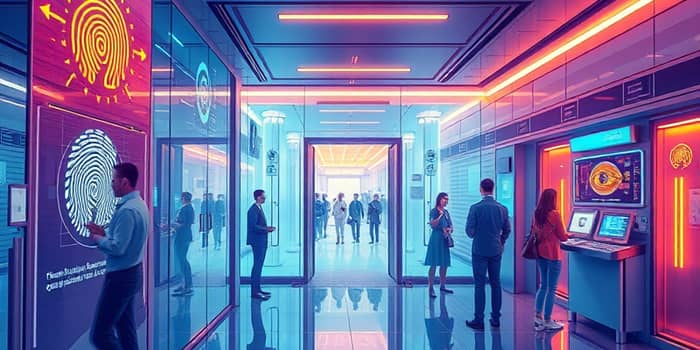
Biometric security is transforming how we authenticate identity and control access, merging cutting-edge technology with everyday convenience.
At its core, biometric security leverages unique biological or behavioral characteristics—from fingerprints and facial patterns to voice and gait—to verify identity. Unlike passwords or PINs, these markers are inherent to individuals, offering a layer of protection that is inherently resistant to duplication and theft.
Biometric systems capture, process, and compare digital representations of these traits, creating templates that guard against unauthorized entry. As adoption grows, so does the sophistication of algorithms that distinguish genuine users from impostors with remarkable precision.
The global biometric security market has expanded rapidly, valued at over $60 billion in 2025. Projections indicate a surge to nearly $95 billion by 2030 and up to $320 billion by 2035, reflecting a sustained compound annual growth rate of 12–20%.
Geographically, the Asia-Pacific region leads in deployment, fueled by national ID initiatives and smart city projects. North America retains a strong foothold, supported by digital infrastructure and enterprise investment. Europe’s growth is bolstered by regulatory frameworks such as GDPR and the EU biometric entry–exit system, which streamlines border checks across member states.
Biometric security has transcended niche applications to become integral in diverse sectors, redefining both user experience and operational safety.
Ongoing advances in AI and machine learning are the engines behind more accurate and secure biometric solutions. Deep learning models refine template matching, reducing false acceptance and rejection rates significantly. Coupled with real-time authentication and adaptive threat detection, systems can respond instantly to anomalies.
Contactless technologies, such as palm recognition and 3D facial scanning, have surged in popularity post-pandemic, emphasizing hygiene without sacrificing performance. Meanwhile, privacy-enhancing computational frameworks—including fully homomorphic encryption—allow encrypted biometric data to be processed securely in the cloud, paving the way for scalable Biometric-as-a-Service (BaaS) offerings.
Despite its promise, biometric security comes with challenges that demand vigilant, ethical design. Privacy concerns top the list: a compromised template cannot be reset like a password. Robust encryption, decentralized storage, and transparent consent mechanisms are vital to instilling user trust.
Spoofing and deepfake attacks remain a threat, but advanced liveness checks and anti-spoofing algorithms—such as infrared-based depth sensing—help mitigate risks. Regulatory landscapes, from CCPA to GDPR and emerging local mandates, require organizations to implement rigorous data governance and bias audits to ensure equitable performance across demographics.
From 2025 to 2035, the trajectory of biometric security points toward deeper integration with wearable devices and the Internet of Things. Smartwatches and fitness bands will harness heart-rate patterns and skin conductivity as continuous authentication factors, reducing reliance on static checkpoints.
Multi-modal systems combining behavioral, physiological, and contextual signals will become the norm in high-stakes environments like airports and financial services. Industry consortia are working toward global interoperability standards, while advances in decentralized identity frameworks promise user-centric control over personal data.
In emerging economies, national ID and healthcare programs will drive mass adoption, offering secure digital identities to billions. As fraudsters deploy ever more sophisticated AI-generated attacks, the arms race between attackers and defenders will hinge on rapid innovation and ethical stewardship of biometric data.
Designing the future of access through biometric security demands a harmonious blend of innovation, responsibility, and user empowerment. By harnessing higher security, convenience and speed, organizations can craft experiences that not only protect but also delight users. As we step into a world where our unique traits unlock doors, manage finances, and safeguard our health, the commitment to ethical design and unwavering privacy protection will determine the true success of this transformative technology.
References