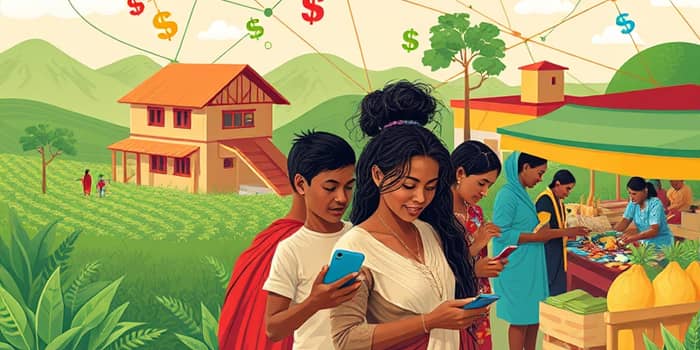
Financial inclusion is no longer a distant aspiration—it is a pressing global movement transforming lives. As technology reshapes economies, the imperative to bring affordable financial services to the 1.6 billion adults still unbanked has never been stronger. This article explores how innovation and collaboration are powering expanding access to financial services and creating real economic opportunity for underserved communities.
At its core, inclusive finance means universal access to payments, savings, credit, and insurance from sustainable providers. It goes beyond opening an account to ensuring that services are affordable, transparent, and tailored to individual needs.
Millions of micro, small, and medium-sized enterprises (MSMEs) as well as low-income households remain excluded, hindered by high costs, lack of formal identification, geographic remoteness, and limited digital literacy. To change this reality, stakeholders around the world are deploying new models that break down those barriers.
Over the last decade, digital transformation has driven remarkable gains in financial access, especially in low- and middle-income countries (LMICs). According to the latest data, account ownership globally has reached 79%, and in LMICs it stands at 75%—an 80% rise since 2011.
Despite this progress, nearly half of the unbanked live in rural or hard-to-reach zones, where digital infrastructure and financial literacy remain weak. In emergencies, almost 50% of people in developing nations cannot cover one month’s expenses—underscoring the urgency for deeper inclusion.
Innovation is the engine propelling financial inclusion forward. From mobile networks in remote villages to digital ID programs in dense urban areas, breakthroughs are reshaping how people access, use, and benefit from financial services at scale.
Programs like the World Bank’s ID4D are enabling legal digital identity programs for the undocumented, while fintech firms harness alternative data—phone usage, social transactions—to underwrite thin-file customers. Governments and private sector partners are also designing data-driven services and open finance ecosystems that protect consumer data and foster competition.
Bridging the digital divide requires investment in networks, affordable devices, and user education. Building financial confidence demands simple interfaces, transparent pricing, and community outreach. Reaching the hardest to serve calls for public-private partnerships, agent networks, and tailored product design.
Kenya’s M-Pesa mobile money platform illustrates the transformative power of mobile finance. Since its launch in 2007, M-Pesa has reached over 30 million users, enabling peer-to-peer transfers, merchant payments, and microcredit. Farmers in rural areas now receive payments instantly, reducing cash risks and boosting productivity.
In India, the Aadhaar digital ID system has onboarded over one billion residents, linking identities to bank accounts and welfare programs. This integration of identity and finance has streamlined subsidy distribution, reduced fraud, and brought millions into the formal economy.
Meanwhile, innovative insurers are offering parametric crop policies. When rainfall dips below a threshold, payouts trigger automatically, protecting smallholder farmers against extreme weather—an example of integrating climate resilience into finance for vulnerable populations.
As financial inclusion evolves, the focus is shifting from simply increasing account numbers to measuring meaningful financial inclusion outcomes—resilience, well-being, and sustainable growth. Key trends to watch include:
Artificial Intelligence and Fintech Integration
AI-driven credit scoring, personalized financial education chatbots, and fraud detection at scale promise to extend services to remote customers while reducing costs.
Climate-Smart Finance
Green loans for renewable energy, crop insurance tied to weather data, and social impact bonds will link inclusion to sustainability goals.
Gig and Merchant Economy Inclusion
Neobanks and digital wallets tailored for freelancers, ride-share drivers, and street vendors will formalize informal incomes and build credit histories.
Inclusive finance is more than a development objective—it is a blueprint for economic empowerment and social progress. By harnessing technology, partnering across sectors, and centering the needs of underserved communities, we can unlock the potential of the 1.6 billion adults still without active financial accounts.
Policymakers must foster enabling regulations and digital infrastructure. Financial service providers need to design user-friendly products and invest in financial literacy. Civil society organizations should amplify community voices and ensure no one is left behind. Together, stakeholders can advance empowering rural and remote communities and build resilient, inclusive economies.
The path forward demands creativity, collaboration, and commitment. When innovation meets intention, we can truly bank the unbanked—and in doing so, ignite opportunities for millions to build secure, prosperous futures.
References