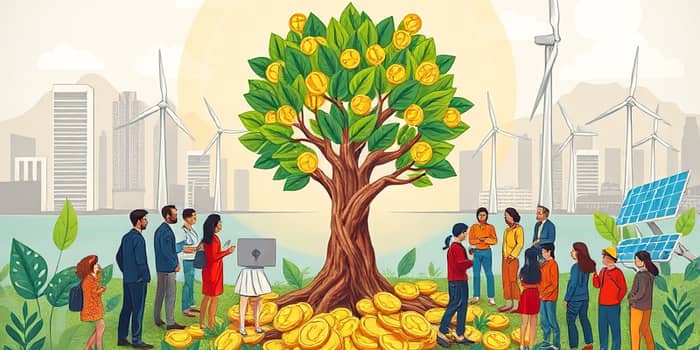
In a world facing climate risks and social inequality, sustainable finance emerges as a powerful catalyst for lasting change. By incorporating environmental, social, and governance factors into investment decisions, individuals and institutions can shape an economy that benefits people and planet alike.
Sustainable finance integrates environmental, social, and governance criteria into capital allocation decisions. At its core, it seeks to direct resources toward projects and companies that deliver positive social and environmental impacts while generating financial returns.
This approach extends beyond traditional metrics of profit, embedding the United Nations Sustainable Development Goals into every stage of assessment. From combating climate change to promoting social equity, sustainable finance offers a framework for responsible economic activities and growth globally.
Over the past decade, the sustainable finance market has soared. In 2024, global assets reached an estimated $6.3–6.9 trillion, with forecasts projecting growth to $13.4 trillion in 2025 and an astonishing $24.3 trillion by 2030. By 2034, experts anticipate assets under management to exceed $40 trillion, driven by a robust compound annual growth rate of up to 20.4%.
Municipalities, corporations, and financial institutions are increasingly issuing green bonds, sustainability-linked loans, and social bonds. In the first seven months of 2025 alone, global issuance surpassed $975 billion, signaling sustained momentum despite regulatory headwinds.
Europe leads through the EU Green Deal and SFDR mandates, while North America benefits from strong institutional commitments. The Asia-Pacific region, though less defined, shows accelerating interest as governments and investors recognize the value of integrating ESG into financial strategies.
The transition to sustainable finance is propelled by multiple forces:
Stakeholders span a broad spectrum: institutional investors, retail savers, development banks, insurance companies, corporations, and impact funds. Their collective engagement ensures that sustainable finance remains a dynamic field, adapting to emerging challenges and opportunities.
Adhering to recognized frameworks and principles is essential for credibility:
Leading organizations implement measures like energy and water efficiency, waste reduction through circular economy models, and community-driven social programs. These best practices demonstrate how financial decisions can yield measurable benefits for people and ecosystems.
A diverse array of instruments enables capital to flow toward sustainable outcomes:
Emerging innovations include blended finance structures that combine public and private capital, enhancing impact while mitigating risk. As markets evolve, product diversity will continue to expand.
Effective impact measurement centers on clear, comparable metrics, such as greenhouse gas emissions reduced, renewable energy generated, water and land usage optimized, and social outcomes achieved. Yet, obstacles remain:
Addressing these challenges demands collaboration among regulators, industry bodies, and market participants to enhance transparency and align metrics. Technological tools like blockchain and AI-driven analytics are beginning to streamline reporting and verification.
Sustainable finance stands at a pivotal juncture. With nearly 79% of US institutional assets under ESG stewardship policies and Europe projecting a $15.28 trillion market by 2034, the movement’s scale is undeniable. Yet, true progress hinges on deepening impact, refining standards, and ensuring inclusivity.
Investors can take tangible steps today:
By harnessing the power of capital markets, we can foster economic growth that not only yields financial returns but also preserves our planet and improves lives. Each investment represents a vote for the kind of future we want to build—one defined by resilience, equity, and sustainability.
As individuals, fund managers, or policymakers, we share the responsibility and opportunity to channel resources toward a better tomorrow. Through sustainable finance, we can achieve long-lasting benefits for communities and ecosystems, proving that profit and purpose can indeed go hand in hand.
References